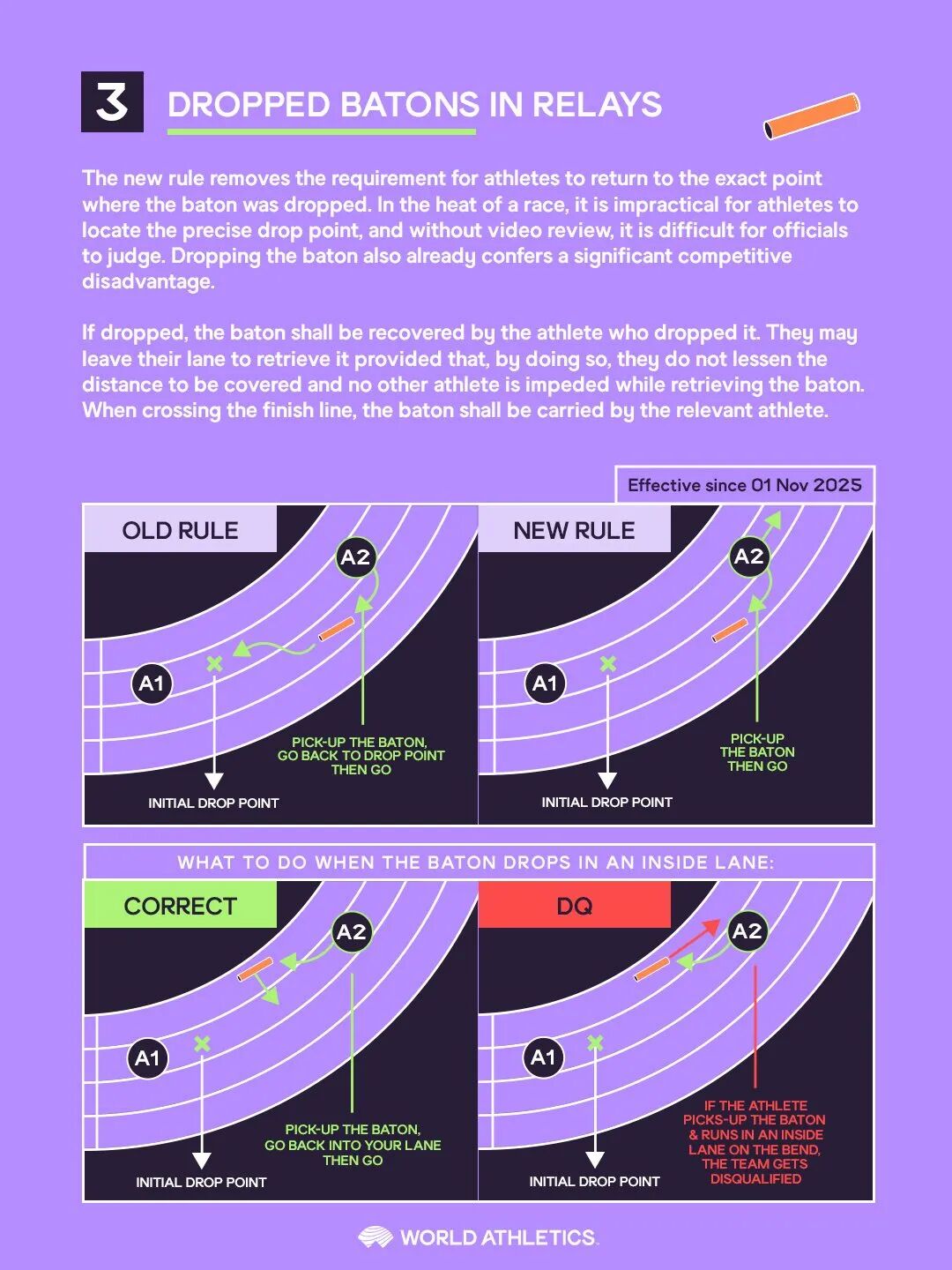
In 2025 we witnessed World Athletics' more athlete-friendly shift in racing equipment and rules — from limiting the stack height of track racing shoes to under 20mm across the board (an equipment-level standard), to introducing a tolerance for stepping on the bend lines — a single step on the line will no longer lead to immediate disqualification but will earn a yellow-card warning.Recently, World Athleticshas issued four key new rules for the 2026 season (first to appear at the 2026 World Athletics Indoor Championships in Toruń, Poland): how will these changes affect the fairness and excitement of competition? Let's take a closer look.Old rule: finals used a single race to decide the winner. Because indoor 200m ovals have tight radii and steep banking, athletes are prone to severe physical collisions when jostling for position.New system: the men's and women's 400m finals will switch to 'grouped finals'. Athletes will be split into two heats, and final placings will be determined by combining the results from both heats.Purpose: to reduce pushing and collisions on narrow tracks and ensure athletes can run to their true level in a less congested environment. This means that even if you are first across the line in the second heat, you could still miss out on a medal if your time is slower than the top three in the first heat.Old rule: Runners typically merged and fought for position after completing the first curve (about 50 meters).New rule: To ensure stability after the start, the new rule extends the distance runners must remain in their individual lanes. Runners must pass a farther specific marker before merging.Purpose: Reduce the risk of trampling and falling caused by cutting to the inside too early at the start.Old rule: If a runner dropped the baton, they had to return to the exact point where it was dropped and restart from there. In high-speed competition this is nearly impossible to pinpoint accurately, and running back can intersect with trailing runners, increasing the risk of collisions and interference.New rule: The rigid requirement to "return to the original point" has been removed. The rule is now simplified: the runner who dropped the baton must pick it up themselves and may continue; briefly leaving the track to retrieve the baton is allowed, provided it does not shorten the required running distance or obstruct other runners. Also, the relevant runner must cross the finish line holding the baton.The intent is clear: dropping the baton already incurs a significant time loss, so the rules no longer add the hard-to-judge requirement of "returning to the original position." At the same time, the new rule also clarifies the bottom line — you may pick up the baton and continue running, but you must not cut the course or impede others; otherwise you may still be disqualified.
Old rule: In 4x400m (and 4x400m mixed, 4x800m) short-track relays, the second, third and fourth-leg runners waiting usually have to wait until their teammateenters the final bend before forming a provisional queue for the exchange zone based on on-track positions. Because the decision point is closer to the handover, there is very little time for athletes to adjust their positions, which can lead to crowding, jostling and mispositioning, and makes it harder for officials to organize the area in time.
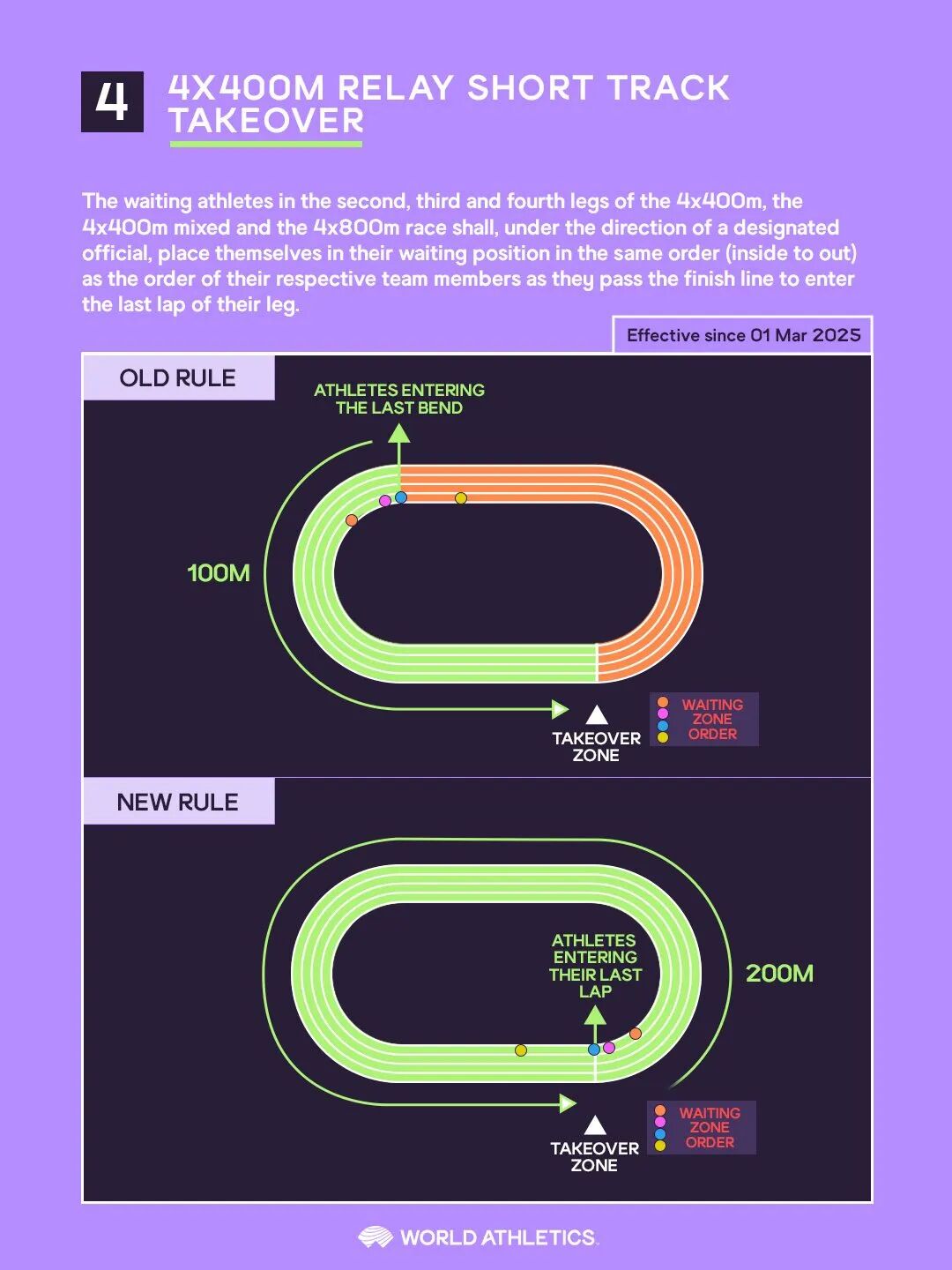
New rule: The queue order in the waiting area is changed tobe determined in advance when the teammate enters the final lap. Specifically:
·The waiting athletes for the 2nd, 3rd and 4th legs must, under the direction of the designated official, enter the waiting positions in the order that their team's previous leg runner crosses the finish line and enters the final lap;when passing the finish line and entering the final lap in that order;
·The queuing method isfrom the inside outward, standing sequentially;
·Applies to 4×400 m,4×400 m mixed,4×800 m.
Moving the decision point for determining positions forward gives waiting athletes more time to complete queuing and positioning, reduces the confusion and physical contact in front of the exchange zone, and also makes it easier for officials to organize and adjudicate, making the competition safer and fairer.
Overall, the direction of these four new rules is clear: to prevent high-risk incidents at their source and to refine the penalty mechanisms for mistakes, making competitions safer and more controllable. Let's look forward to the 2026 indoor season and keep delivering even more exciting speed and stories.
Text:Training Notes / Editor: xiaocai
Image: Trail Running Explosion & Online / Visuals:Five YearsTrainee