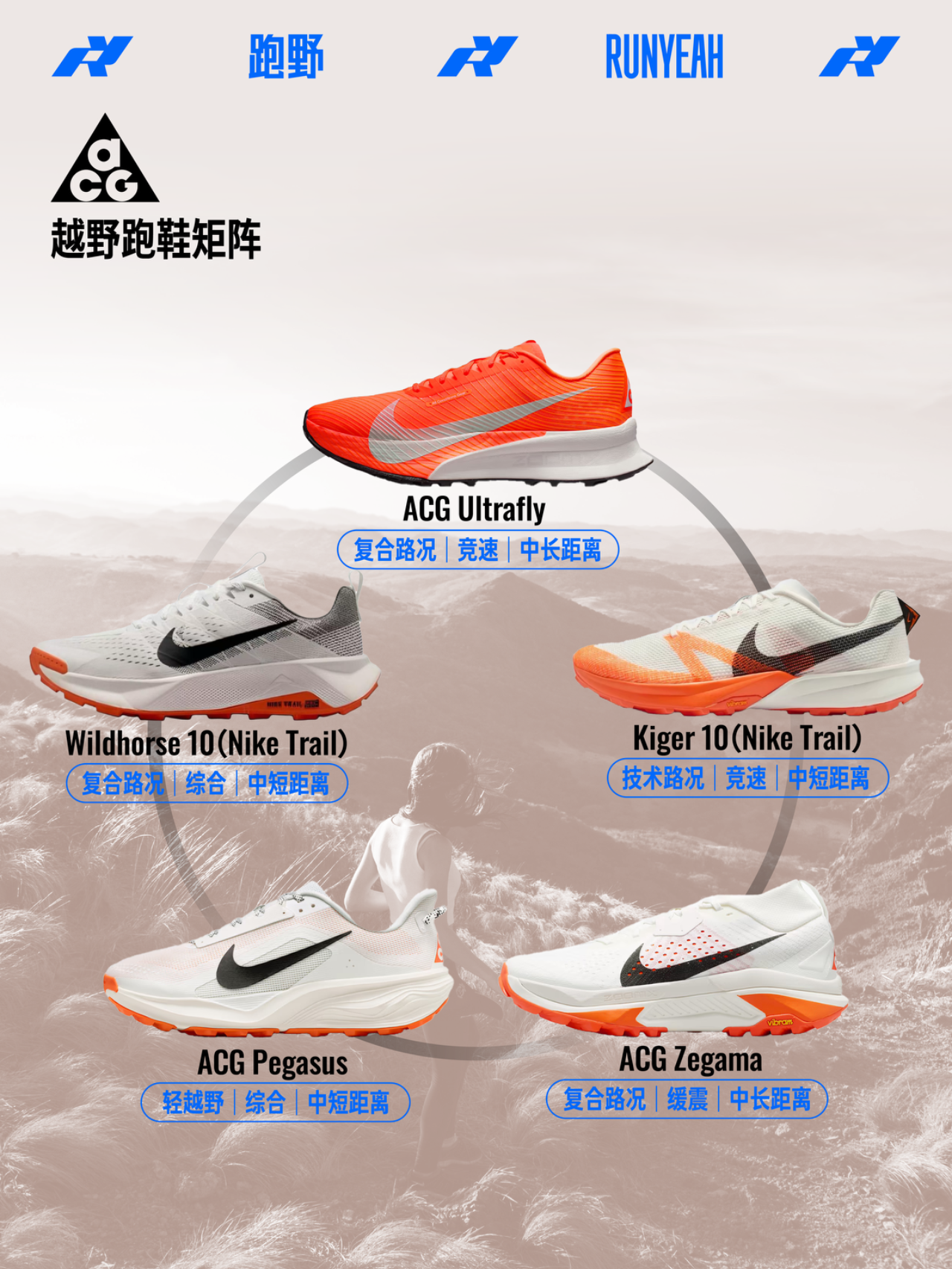
ACG, which originally leaned more toward outdoor and techwear styles, has in recent years put a lot of effort into trail running.
Beyond sponsoring major trail races, the main move was folding the former Nike Trail Running product line into its own brand, enriching and professionalizing its product matrix. From racing to light trail, there's a product for each need.
The ACG Ultrafly was already revealed at last year's Western 100 trail race.
Compared with the relatively steady performance of past Ultrafly models, the new generation uses a "segmented" carbon plate for the first time in its carbon plate structure, maintaining rigidity while improving lateral and longitudinal flexibility. Improvements to outsole lug length and pattern provide more reliable traction across all terrains.
With supercritical brittle foams becoming increasingly common in trail running shoes today, the tear resistance of the mid-/rearfoot lateral foam in the ACG Ultrafly will also be put to the test, so the forefoot's upper foam still receives the same "anti-tear film" treatment as previous Ultrafly models.
The Kiger 10's thin-sole design gives it an inherent advantage in responsiveness and ground feel, while the soft Cushlon 3.0 foam and wide last make the comfort feel unlike a typical thin-soled shoe. With Vibram's outsole and LITEBASE tech completing the "three-piece set", there are basically no reasons to fault this shoe.
Beginners can wear it to feel and train for negotiating technical terrain and build strength; for serious runners, it can absolutely become a weapon for middle- and short-distance racing.
The ACG Zegama, meanwhile, is a cushioned trail running shoe aimed at ultra-long/long-distance races.
Cushlon 3.0's outer frame is internally filled with a belly-style ZOOMX foam and higher turned-up sidewalls, giving the shoe softness, responsiveness, and stability.
The dual-layer engineered mesh stands up to long-distance tests in both breathability and tear resistance; more importantly, it's currently ACG's only "bootie" construction. The comfortable mid-height collar both prevents ankle chafing and reduces ingress of sand and stones over long distances.
The ACG Pegasus is more like a gravel bike in shoe form, balancing urban streets—fire roads—gravel tracks typical of light trail routes.
Full-length ReactX foam gives the shoe a balanced level of rebound and cushioning. It combines a trail shoe's terrain adaptability and traction with the nimbleness of a road shoe.
Though the Wildhorse 10 feels niche, its thinner upper, larger outsole area, and thicker full-length ReactX midsole setup make it more comfortable and stable for mid- and short-distance trail runs.
Going forward, will ACG's "refinement" in trail running gear follow other brands by changing plate structures to increase stability while maintaining propulsion? Or will they refresh midsole properties? Or bring higher-precision upper technologies? We'll wait and see.
#ACG #trail running #trail running shoes #Trail Running Explosion#running shoe matrix