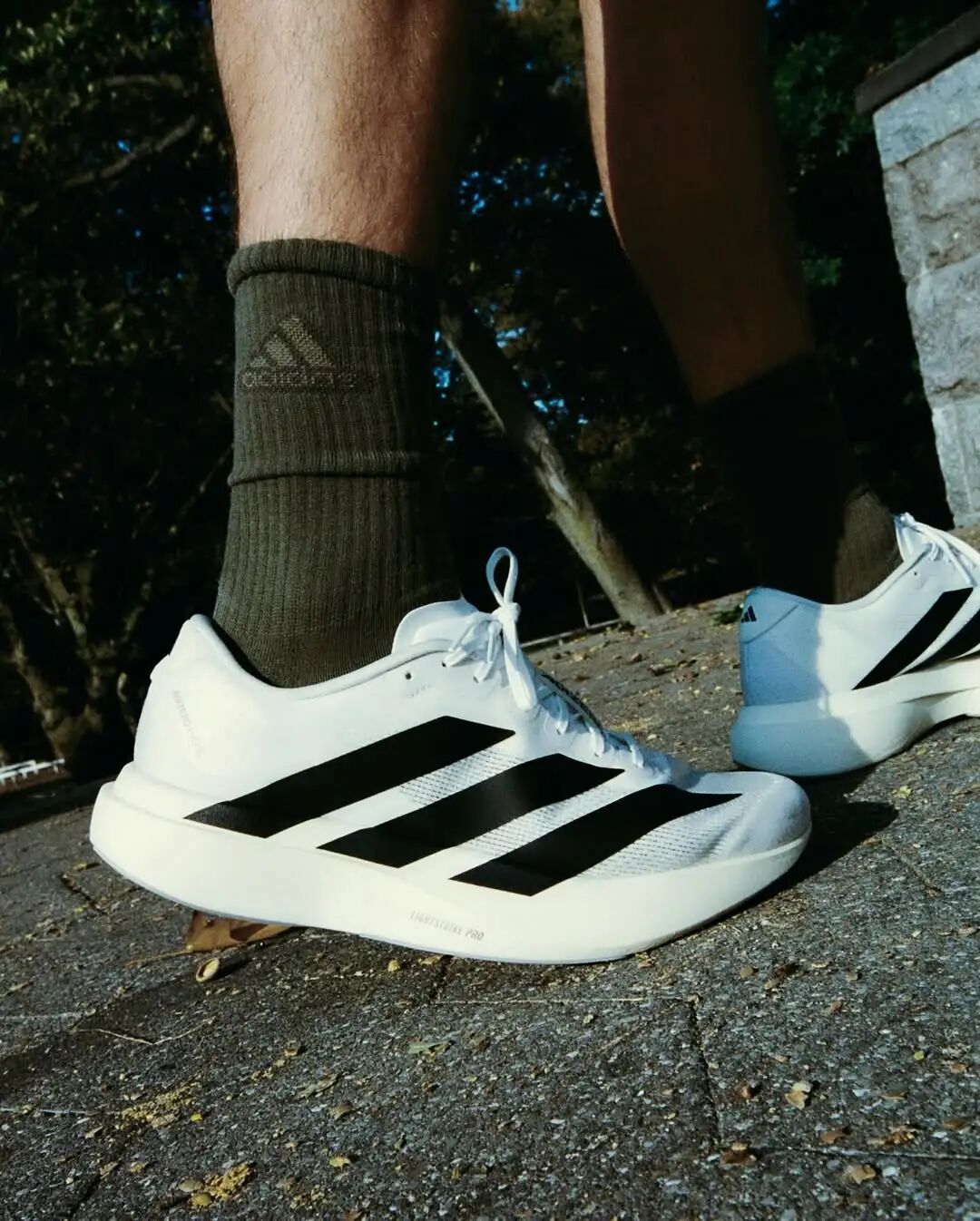
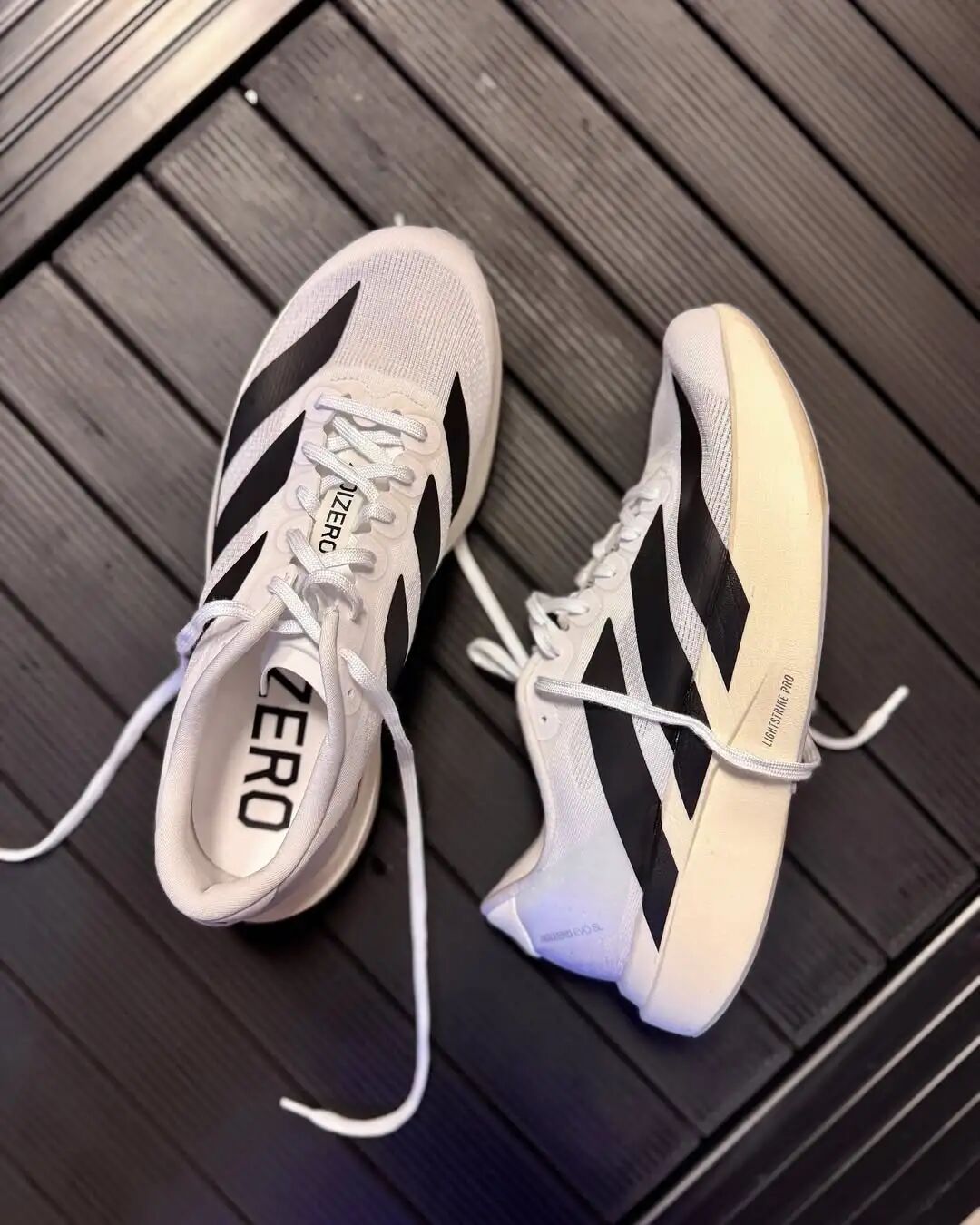
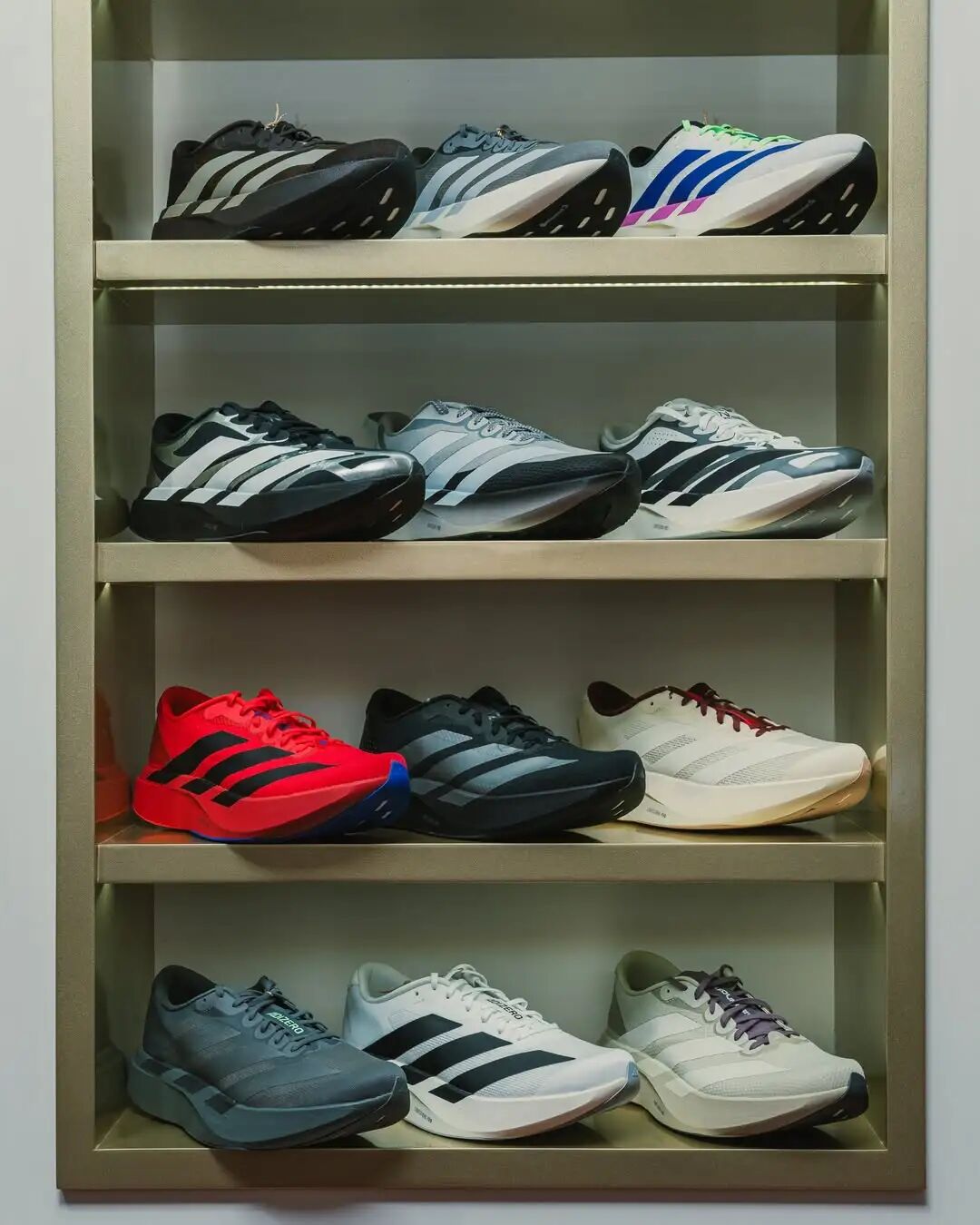
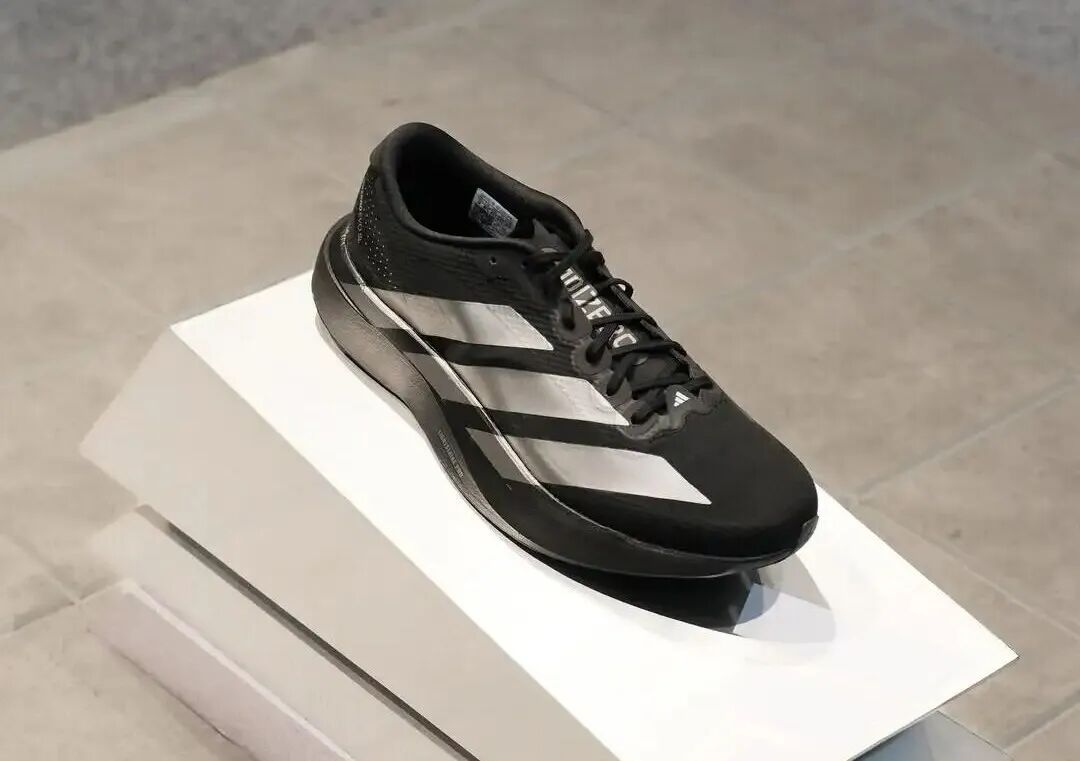
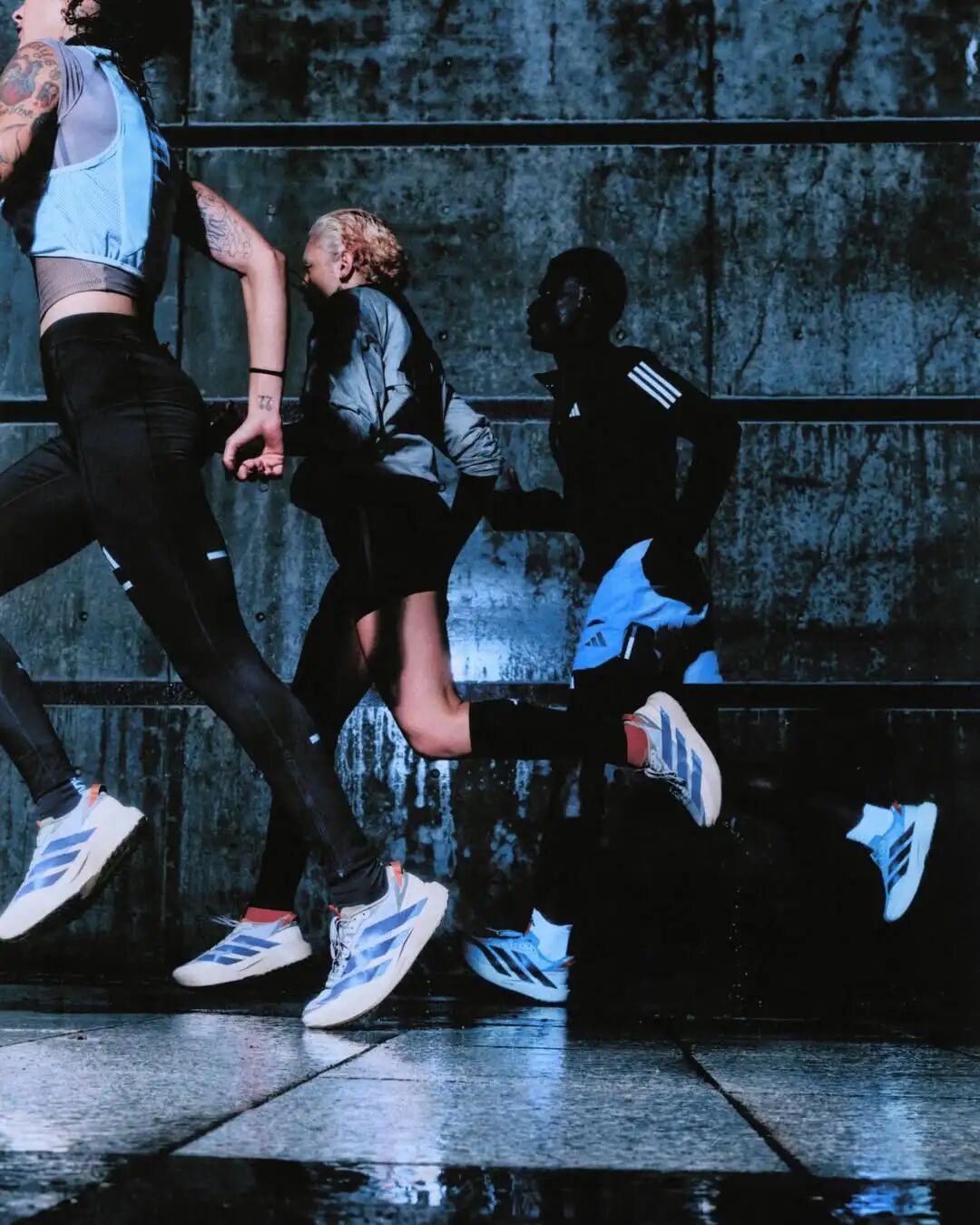
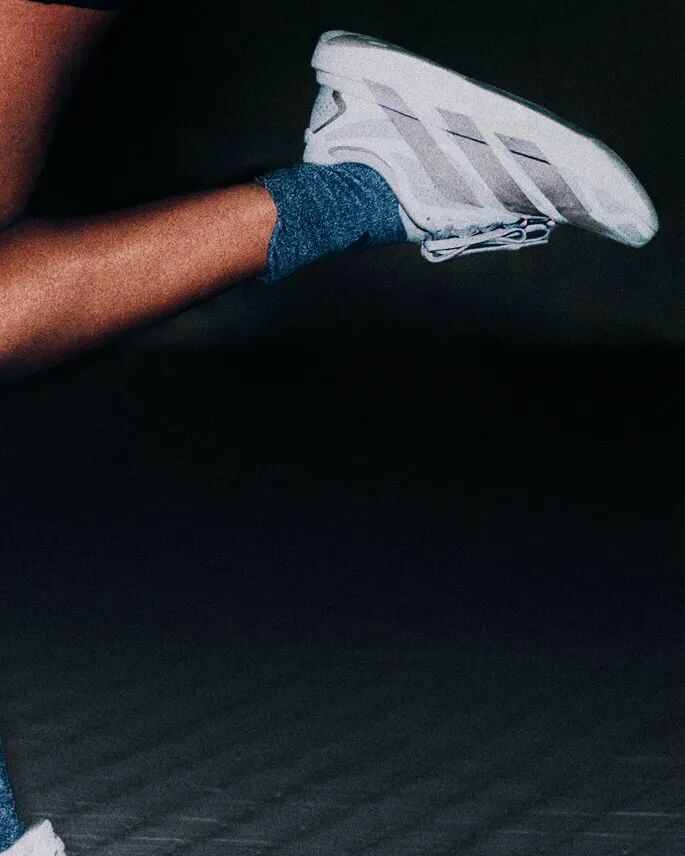
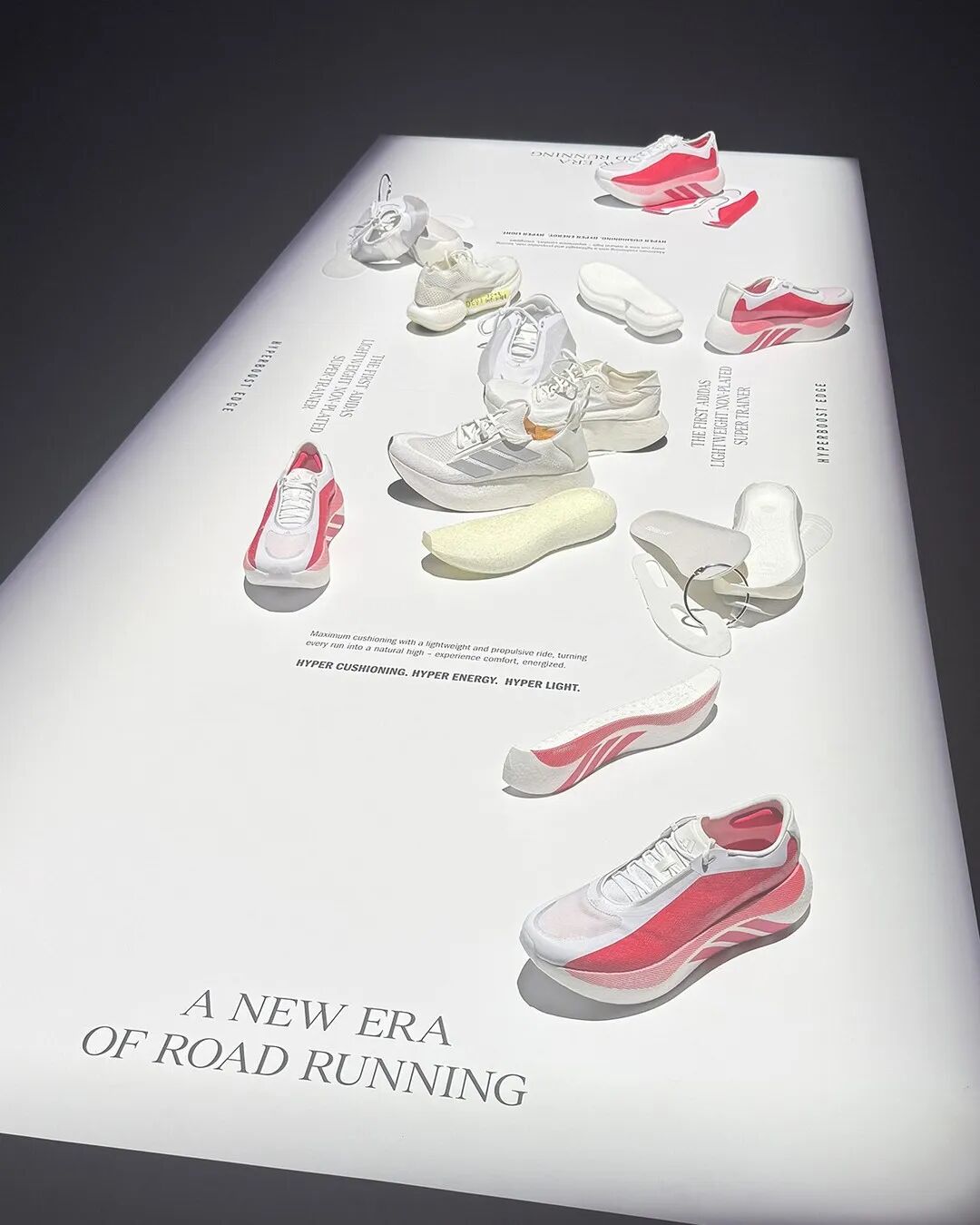
At adidas's high-profile new-product launch in autumn 2024, the spotlight was originally intended for a more aggressive top-tier racing shoe. That day, adidas unveiled ADIZERO ADIOS PRO 4 and ADIZERO EVO SL, two core models in the lineup. The former is an aggressively pure top-level race-day shoe; the latter is positioned as a more everyday, all-around, and more suitable "super trainer" for most runners. On paper, the ADIZERO ADIOS PRO 4 has an overwhelming advantage: its signature bionic carbon 'claws' deliver exceptional propulsion, and it is ADIZERO EVO SL a full 11% lighter, giving it a distinctly race-oriented character. Both shoes use LIGHTSTRIKE PRO premium foam in the midsole and feature a visually striking design — an exaggerated adidas three‑stripe logo that wildly flows downward like blood and merges with the midsole. Yet time has delivered an astonishing verdict. Looking back from today, theEVO SL, which on the surface seemed like a technical compromise, has created a jaw‑dropping commercial success and a word‑of‑mouth legend for adidas. At adidas's fiscal 2025 final earnings conference call, CEO Bjørn Gulden officially announced a blockbuster figure:EVO SL's global sales have neared the 10 million pairs mark, becoming adidas's best‑selling running shoe product in many years. So, why would a training shoe without a carbon plate and not positioned as a top-level racing model becomeadidasone of the most phenomenon-defining running shoes in recent years? EVO SL The core logic behind the EVO SL's success isn't complicated: it's not a shoe built solely for elite runners. Compared withany of the super shoes on the market equipped with propulsion systems,EVO SL offers a more forgiving, more universally applicable experience. The brand defines it as a multipurpose running shoe and emphasizes an "ultra-light feel" and use cases that balance training and speedwork. This point is crucial. After all, among the vast population of runners, those who can truly handle elite full marathon paces are only a small minority at the top of the pyramid. The main driving force behind running-shoe purchases is the large number of ordinary runners who want a single pair of shoes to cover more training needs. EVO SL precisely meets that need:In an era when major brands are aggressively advocating the 'matrix' concept and urging runners to build an extensive shoe closet for different paces and training sessions,EVO SL, thanks to its unparalleled versatility, offers a more universally accessible sense of speed and balance:Whether it's easy daily mileage accumulation, tempo runs that demand steady output, or simply an easy jog,EVO SL can handle them all with ease, providing satisfying underfoot feedback. Put another way, its success wasn't just because it had "decent performance"; it happened to sit at the intersection of the broadest groups of running-shoe consumers.But that's only EVO SL's surface-level reason for success; it doesn't fully explain why it managed to stand out in the cutthroat running-shoe market. adidas is not the absolute originator of the "super trainer" concept; this subcategory has long been a red sea, crowded with powerful competitors featuring various propulsion plates or full-foam constructions. However,EVO SL has been able to pull ahead in this crowded, elite-level battle largely thanks to its highly aggressive pricing strategy. Against a backdrop of price inflation in high-end non-carbon-plate training shoes,EVO SL entered the market at a price that lets you pick up a pair on the secondary market for just a few hundred yuan, creating a textbook example of disruptive undercutting. For core runners who need to replace shoes frequently to cope with high-mileage training,EVO SL has shown unparalleled value for money. Beyond its price advantage, its distinctive looks are also key to breaking through. Today's running shoe market is highly homogenized.EVO SL is an instantly recognizable shoe: it inherits the design language of the brand's top racing models — exaggerated, stretched three stripes and a chunky-but-not-clunky midsole profile,combining a sense of speed with street appeal to deliver a strong visual impact. Its appeal has long since crossed the boundaries of pure running and is rapidly permeating a wider lifestyle audience. Many non-runners are now drawn to its combination of exceptional comfort and a rugged aesthetic that's "simple but not simplistic." This has helped EVO SL reach a much wider audience: it's no longer just a training shoe, but is increasingly seen as something you can commute in, wear around town, or even style with everyday outfits. That hybrid quality — it runs well, is wearable day-to-day, and photographs well — is something many traditional trainers don't have. In addition, adidas has also demonstrated strong product iteration and color management capabilities,and to meet the needs of different communities,EVO SL had a limited launch in autumn 2024, followed by a massive, widespread release in spring 2025. Then, in the following autumn, adidas capitalized on this momentum and launched two major derivative models: EVO SL WOEN: uses a closer-fitting knit upper and adds an integrated, semi-fixed tongue to keep out sand and prevent the foot from shifting. EVO SL ATR: an all-terrain version designed for complex terrain and changing weather, equipped with a water-repellent upper and an outdoor outsole featuring mildly anti-slip lugs. And just this month, the series welcomed a new member——EVO SL EXO. This new derivative adds a heat-pressed overlay design to the upper, which not only greatly enhances fit and lockdown, but also provides richer visual possibilities for color blocking. The launch of these derivatives is the core lifeline for maintaining EVO SL's sustained popularity; this product strategy is far more effective than simply 'changing the colorway'. "If you look back at the development history of the Samba, you'll find that what has truly kept it enduring is those derivative variants." "The core base model may not always hold the top market heat, but those Mary Jane editions, ballet-flat versions, floral materials, animal textures — those elements are exactly what keep the Samba feeling fresh today. When you roll out different versions, you're giving consumers a reason to put a second EVOSL into their wardrobe, and not just because 'it's a pink shoe'." Although EVO SL's meteoric surge in the market shows no sign of slowing, but adidas is already preparing for the next wave. In just a few days, a new running shoe poised to carry on EVO SL's successful formula will be launched — HYPERBOOST EDGE. This new shoe is also positioned as a "super training shoe", but its mission is to fill a gap in adidas's lineup for "extreme cushioning". More importantly, it features a major material innovation called HYPERBOOST PRO. This is a unique supercritical foam formulation presented in the familiar granular form runners know well, which inevitably brings to mind the BOOST technology that once had a profound impact on the entire industry. Patrick Nava, General Manager of adidas Running, when discussing the development background of the HYPERBOOST EDGE, revealed the intricate connections with EVO SL: “When developing EVO SL, we posed a hypothesis: 'What if we stripped out all those stiff propulsion systems from the midsole, slightly reduced the midsole stack height, and then tried to build a super training shoe based on that?' It was following that idea that we began to explore the HYPERBOOST concept, and we ultimately arrived at this new granular material which, while remaining extremely lightweight, delivers a striking energy-return solution.” Before EVO SL burst onto the scene, the last time adidas created such a sensational 'hot seller' in running shoes was with the 2015 release of the first-generation ULTRABOOST. Therefore, it makes perfect sense—and carries real significance—that the brand's next flagship product would draw inspiration from these two milestone models. For Adidas' competitors, taking the EVO SL from the pedestal of the "ultimate training shoe" will be an extremely daunting challenge. At the same time, beating Adidas on the top marathon stage is equally daunting — among the 12 World Marathon Majors races in 2025, 7 winners wore ADIOS PRO EVO 1 or EVO 2. If the forthcoming HYPERBOOST EDGE can, as expected, replicate EVO SL's path to success, then on future tracks we may witness the spectacular sight of adidas's three top technology lineups simultaneously dominating the running market. The next technological and commercial showdown in the running shoe industry has only just begun.
Translated by:Paoye /Editor:xiaocai Images:Paoye Big Bang/Visuals:Max