

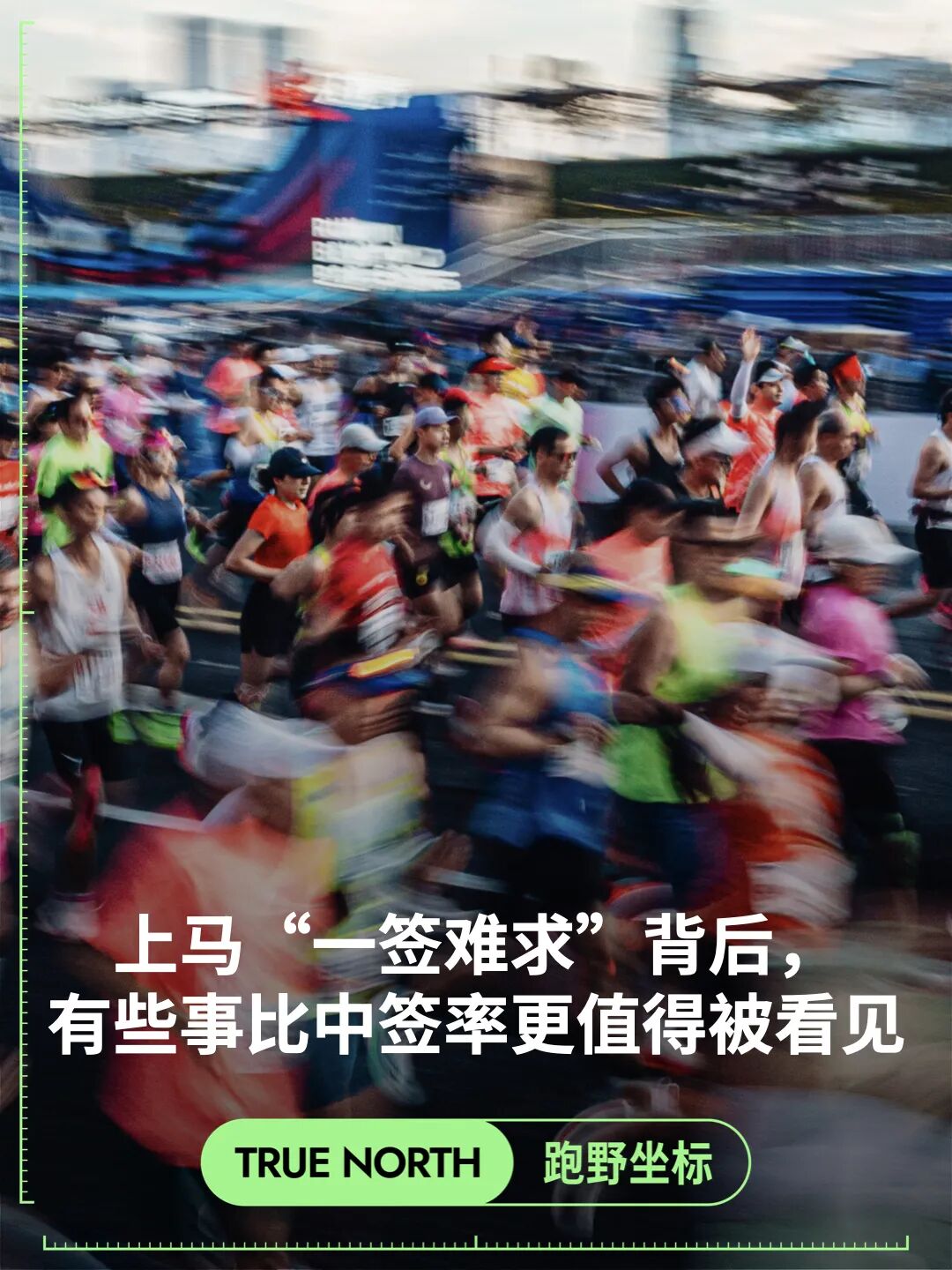
On June 30, the list of successful applicants for the 2026 Shanghai Marathon was officially announced. 381,988 people registered, and the overall lottery acceptance rate was only 6%, the most intense competition in the event's history. However, after the results were released, alongside the usual “some rejoice, some lament” reactions there were also quite a few voices of criticism within the running community.
Some people calculated from the lottery rate that the public lottery only had a little over 20,000 spots, and on that basis accused the Shanghai Marathon of “violating the CAA's 90% rule”; others targeted the ITP travel packages aimed at overseas runners, criticizing that “Chinese people can't buy them” as unfair.
Some of these criticisms stem from information asymmetry, others ignore the special development stage the Shanghai Marathon is in. Before responding to these voices, perhaps we should first look at the bigger picture: 2026 is the 30th anniversary of the Shanghai Marathon and a critical year in its bid to enter the World Marathon Majors.
Over 30 years of organizing the race, from being a domestic leader to attaining World Athletics Platinum Label and becoming a candidate for the World Marathon Majors, the Shanghai Marathon has followed a path of long-term development. At this special juncture, some controversies need clarification, some misunderstandings need resolving, and some things are more worthy of attention than the lottery rate.
01
Lottery rate 6%, public spots below 90%
Numbers need to be correctly interpreted
The core logic of netizens' criticism is: total registrations 381,988 × lottery rate 6% ≈ 23,000 people, whereas the total event size is 30,000; the difference of about 7,000 people did not enter the public lottery pool, therefore the Shanghai Marathon violated the CAA's rule that “the number of spots for mass runners should in principle be no less than 90% of the total event size.”
This deduction looks rigorous but contains multiple levels of misinterpretation.

In 2025 the Chinese Athletics Association issued the “Notice on Further Standardizing Work Related to Marathon Events,” which requires that “the number of spots for mass runners in each event should in principle be no less than 90% of the total event size.” But the three words “in principle” indicate room for flexible adjustment and are not an absolutely rigid hard limit.
More importantly, the definition of “mass runners” does not only refer to the lottery pool; runners who qualify by achieving qualifying times and gain direct entry also fall within the category of mass runners. Equating “mass lottery spots” with “spots for mass runners” is a narrow interpretation of the regulation. Therefore, equating the Shanghai Marathon's mass lottery of 23,000 spots with 90% of the total mass runner quota is itself a numerical misinterpretation.
The Shanghai Marathon's entry allocation comes from many channels: public lottery, direct qualifiers (including top 200 in the Shanghai Women's Half Marathon; top 150 men/top 100 women in the Suzhou River Half Marathon; top 200 men/top 100 women in the Shanghai Half Marathon, etc.), invited elite athletes, sponsor spots, international tourism runners (ITP) spots, etc. These channels together make up the total 30,000 participant field.
In fact, the expansion of the event's capacity itself shows considerable goodwill. The 2026 Shanghai Marathon full marathon spots expanded from the usual 23,000 to 30,000, an increase of 7,000. Facing sustained growth in runners' enthusiasm, the organizing committee has released as many additional spots as possible.
But increasing spots for a marathon affects many systems. Course capacity, traffic organization, medical rescue, aid stations, volunteer deployment, management along the route and the city's operational order all face great tests on race day. A truly high-level city marathon must let runners have a great race while ensuring the city runs smoothly and orderly — striking that balance is precisely where professional event management shows.
If compared horizontally with the international majors, Shanghai Marathon's mass lottery proportion is not low. Based on estimates, the 2026 Shanghai Marathon's mass lottery had about 23,000 spots, about 76% of the total 30,000. This proportion, compared across World Marathon Majors races, is not “low” but rather quite generous.
Here are some numbers: the New York Marathon has a field over 60,000 but only about 2,400 spots are allocated to the public lottery; the Boston Marathon doesn't have a traditional public lottery — about 80% of spots go to time-qualified runners; the London Marathon's field is close to 60,000 with lottery spots between 17,000 and 20,000, with more spots allocated to charity; the Tokyo Marathon has a field of 38,000, of which about 30,000 spots are used for the lottery.
By comparison, the 2026 Shanghai Marathon's lottery share of about 76% is roughly on par with Tokyo Marathon and significantly higher than New York, London, and Boston in openness to public lottery. In other words, Shanghai Marathon has already been at the forefront among top international events in ensuring mass participation.
Therefore, interpreting “a 76% share of public lottery spots” as “violating the CAA's 90% rule” ignores the flexible “in principle” allowance, narrows the definition of “mass runners”, and overlooks the internationally common multi-channel allocation model. If we follow some netizens' logic, with New York Marathon's lottery share at under 5% and Boston Marathon having almost no lottery, would those events also be judged “unfair”?
Obviously not; diversity in entry allocation is itself an industry norm for large marathons.
From a more macro perspective, over 380,000 registrations and an approx. 6% lottery rate means the majority of runners still have to wait. But a city marathon that can get so many people to register year after year, to wait and expect, is itself a real testament to its reputation. The Shanghai Marathon's “entry is hard to come by” image, on the surface about scarce spots, speaks more deeply to the race's concentrated appeal.
02
“Overseas travel packages” — Chinese runners can't buy?
Fairness shouldn't be oversimplified
Another controversy is the ITP (International Tourism Participant) program. As the Shanghai Marathon's official packaged product offering direct entry + travel services for overseas runners, the program is explicitly limited to overseas applicants; runners from mainland China and Hong Kong, Macau, and Taiwan cannot register. Some runners questioned: why can't Chinese people buy it?
This sentiment of questioning is understandable, but needs to be viewed within a larger framework.
First, this is common practice among top international events, not discrimination. Tokyo Marathon, London Marathon, Boston Marathon and other World Marathon Majors all have travel packages or direct entry channels aimed at overseas runners, and the share of spots is not insignificant. This is a standard configuration of top international events, intended to attract global runners and enhance the event's international influence. As a candidate for the World Marathon Majors, Shanghai Marathon aligning with international standards is only to be expected.
Second, the Shanghai Marathon is at a critical stage in its bid for the Majors. The World Marathon Majors aren't just an honorary title but a set of strict event standards. They evaluate not only elite athlete fields and competition levels, but also event organization, runner services, city security, international communication and overall operational capacity.
The ITP program is an important initiative by Shanghai Marathon to align with Majors standards and raise its internationalization. The 2026 Shanghai Marathon has already attracted 13,973 international registrants from 116 countries and regions, with internationalization increasing year by year, thanks in part to programs like ITP.

Third, there is already a clear disparity in treatment between domestic and foreign runners, but in the opposite direction. Chinese runners pay 200 RMB per person, while foreign runners pay $160 USD per person (about 1,150 RMB); the foreign runner fee is nearly six times domestic.
Fourth, fairness should not be oversimplified. “Fairness” does not mean “every channel is completely open to everyone.” Different channels serve different groups and purposes. The public lottery ensures basic fairness, direct qualification incentivizes strong runners, sponsor spots support event operations, and international channels boost the event's profile. These channels each have their function and together form a complete entry allocation system. Picking any one channel out and calling it “unfair” would be a biased judgment.
Moreover, the Shanghai Marathon has always focused on Chinese runners as its main participants; the vast majority of the 30,000 full marathon spots are still open to domestic runners. Serving local runners well while actively expanding international influence are not contradictory.
03
30th anniversary — the Shanghai Marathon's bigger picture
Returning to a more fundamental question: by what standards should we judge a marathon?
If you only look at the lottery rate, 6% is indeed frustrating. But if you see that in just four years Shanghai Marathon's registration numbers more than doubled, that full marathon spots rose from 23,000 to 30,000, and that the event grew from a domestic leading race to a World Athletics Platinum Label and then a candidate for the World Marathon Majors — that growth curve itself is a microcosm of the booming development of Chinese marathons.
In 2026 the Shanghai Marathon will hold the Health Run and the full marathon on two separate days. This arrangement allows the full marathon to focus more on a professional experience while also leaving more room for mass participation. Top events shouldn't be just a festival for a few lottery winners. Some run the full marathon, some take part in the Health Run; some are on the course running, others cheer from the sidelines; some volunteer, others are starting to run for the first time because of this event. All of these are part of the Shanghai Marathon.

The higher you aim, the more you must prioritize runner experience and mass participation. The Shanghai Marathon has been striving at this over the years.
Questioning drives progress. Runners' attention to the Shanghai Marathon's entry allocation and their probing of fairness show the high expectations for the event. But no race can develop overnight; the Shanghai Marathon's 30 years of accumulation are the result of improving details and raising standards year after year.
The contradiction behind 30,000 spots, 380,000 registrations and a 6% lottery rate is essentially between the marathon industry's rapid development in China and the relative scarcity of high-quality event resources. This contradiction cannot be solved by criticizing a single race; it needs the collective effort of the whole industry.
Before that, it might be worth giving the Shanghai Marathon a little more understanding and patience. After all, an event that makes people return year after year to wait and hope deserves to be taken seriously.
[Reader Interaction]
Text/Editor: CC
Images: 跑野大爆炸
Visuals: Max