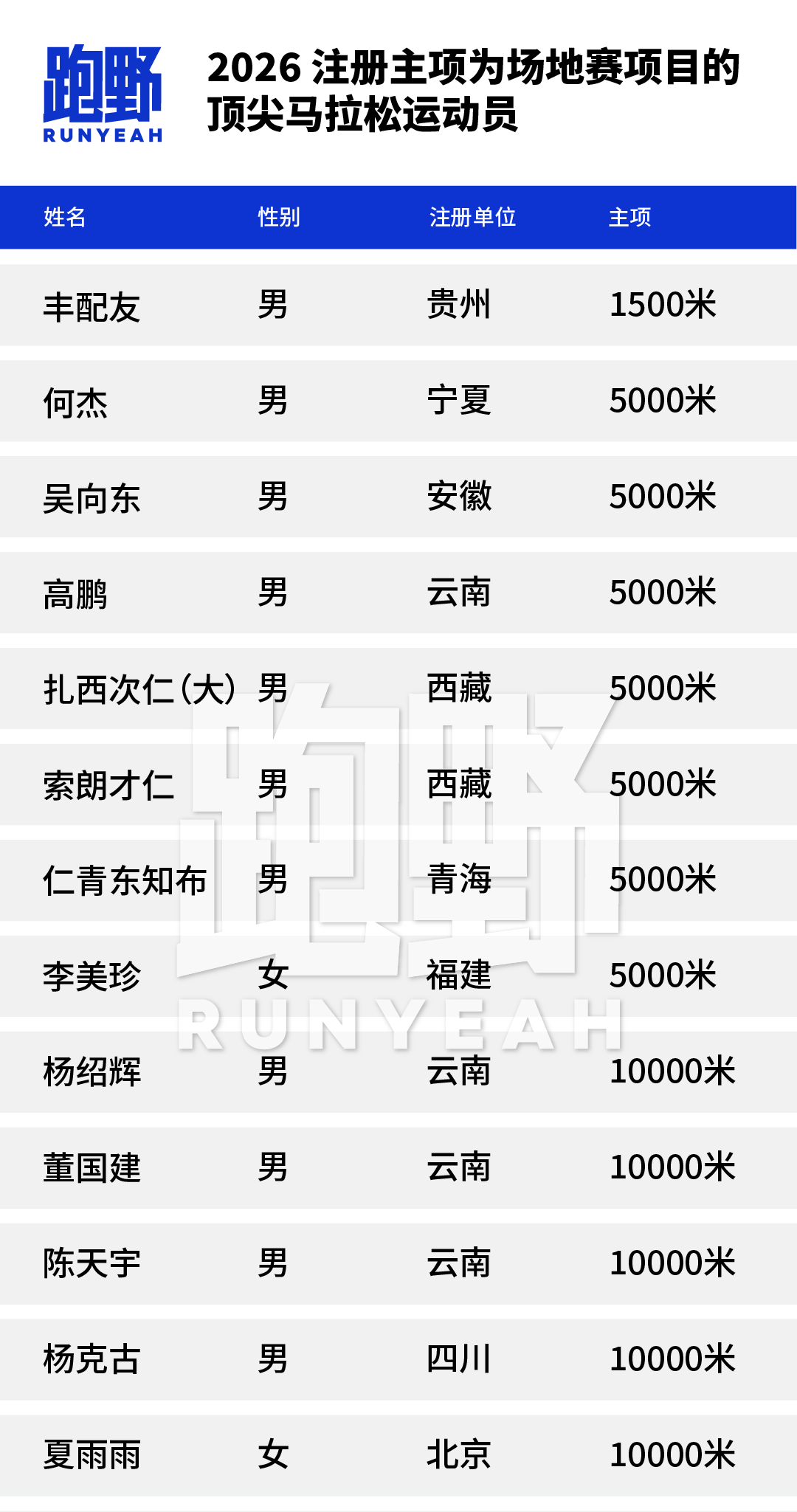
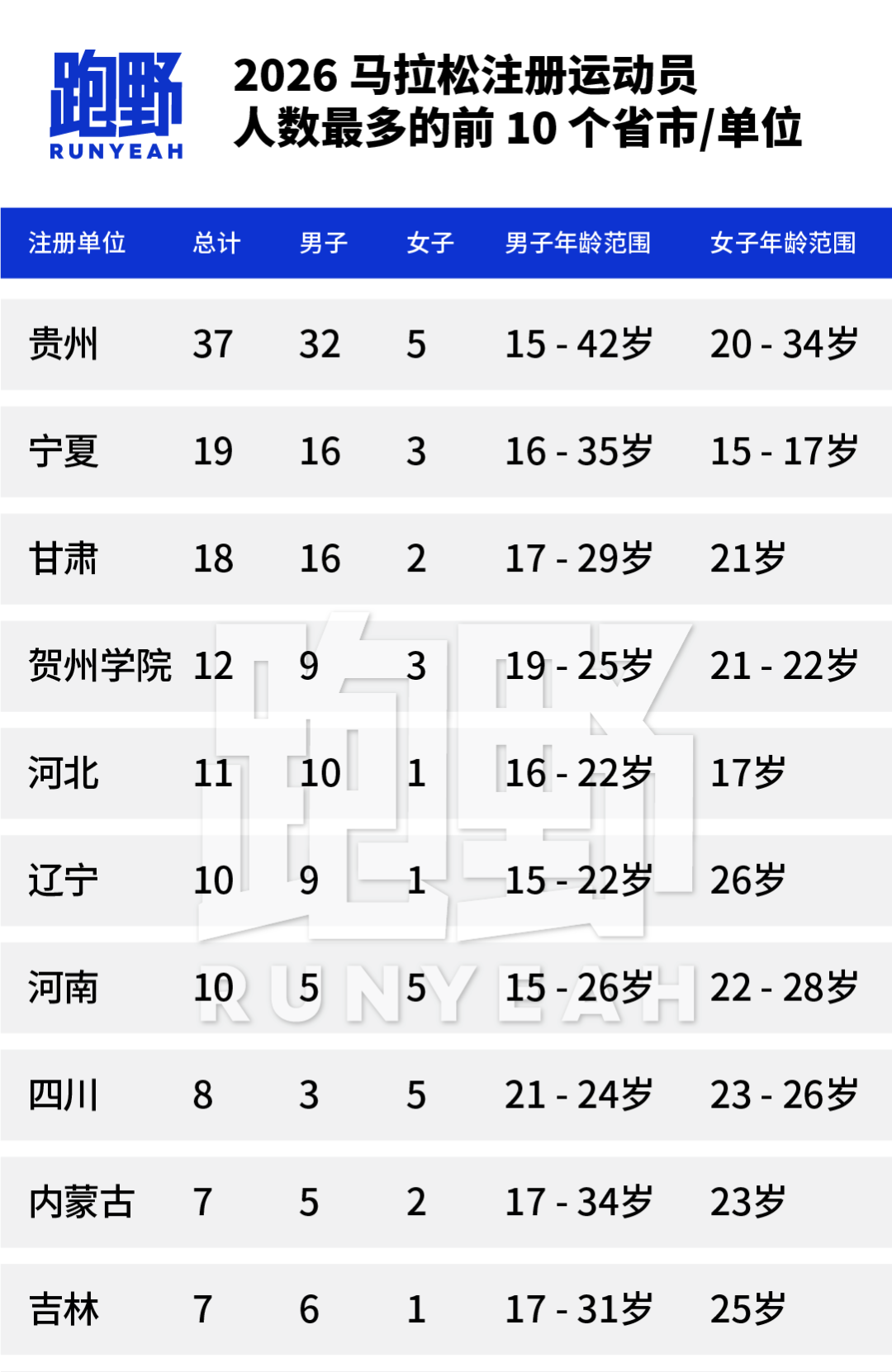
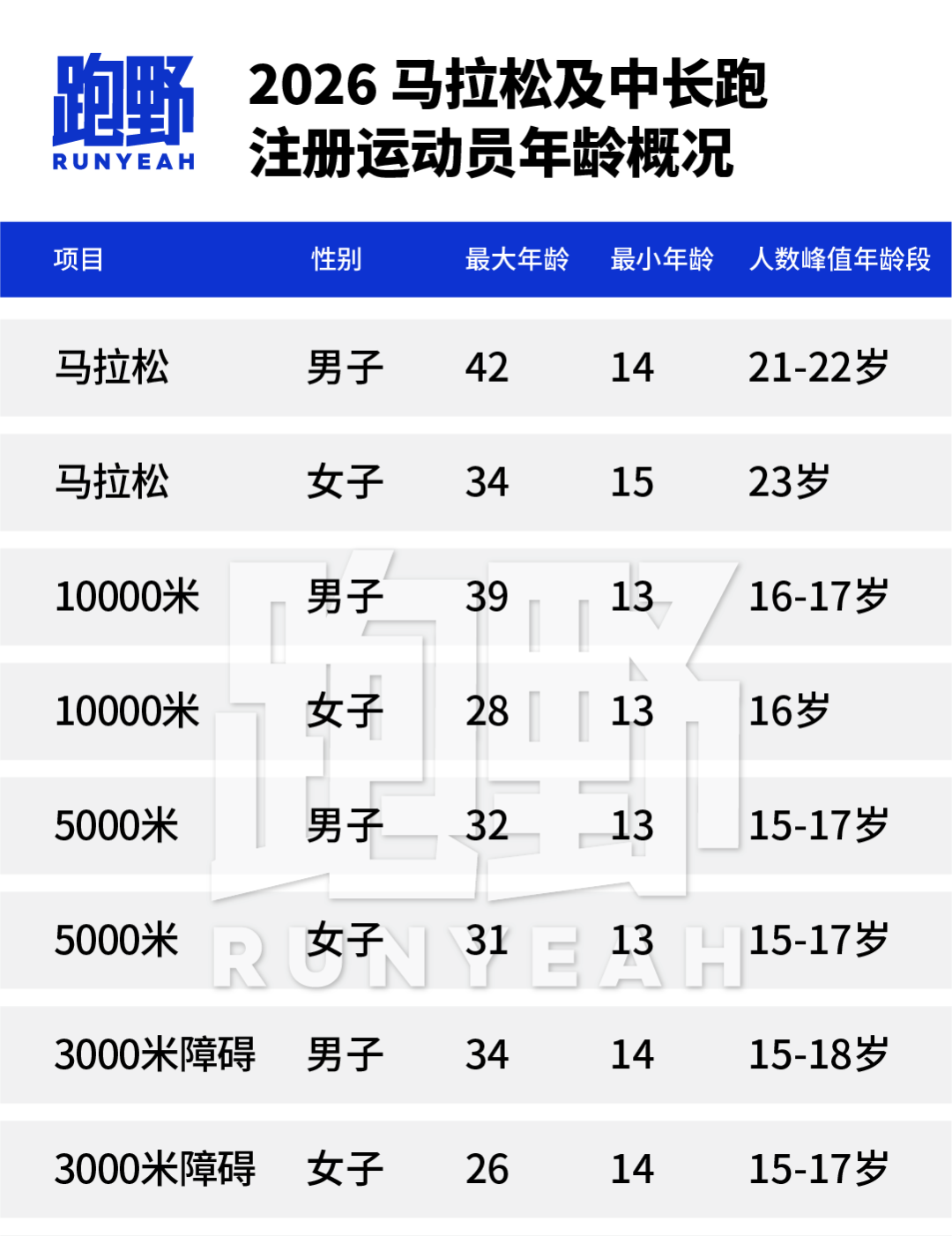
Recently the Chinese Athletics Association carried out the 2026 review of registered athletes and coaches, and the information obtained has revealed several new developments in China's marathon and middle- and long-distance running, Today we'll take you through them in detail. This year, the number of athletes registered with the marathon as their primary event is 197 in total, an increase of 31.3% compared with last year . Of these, 156 men, accounting for 79.2%; 41 women, accounting for 20.8%. These proportion figures are almost identical to the male-to-female ratio of marathon runners in the 2025 Marathon Blue Book. It should be noted that among top marathon athletes, many have a primary registration in events other than the marathon; this does not prevent them from competing in marathon events. It may simply be the event they chose when they first registered. This year, the developments surrounding several well-known athletes are a key focus. Guan Yousheng and Jia Erenjia moved out of the state system and back into independent status.Peng Jianhua and Bai Li began a period as non-registered athletes. Yin Shunjin and Xue Jun did not register due to doping violations, and Li Bo, who was involved in a doping scandal, also did not register. Li Zhixuan, who felt that both the state system and the independent path had their pros and cons, ultimately transferred from Shanghai University of Sport and completed her registration with the Shanghai team. Veteran Dong Guojian, who once planned to deliver his 'final dance' at this year's Xiamen Marathon, chose to continue competing after completing registration with the Yunnan team. There are also some well-known athletes who have "newly registered": Yan Wei (national championships 5000m champion) and Li Jingfen (national marathon championships champion, Xiamen Marathon champion) have rejoined the Guizhou team. Zhao Changhong, Bao Bilige, and Xu Wang have changed their registered teams. Zhao Changhong, who had been retired for a while, chose to join the Gansu team,Bao Bilige has returned to the Inner Mongolia team from Hebei, and Xu Wang has moved from Liaoning to Ningxia. Wang Zhuang and Feng Dan have transitioned from unaffiliated runners to registered athletes. Wang Zhuang registered with Henan Normal University, while Feng Dan joined the Henan team, which is strong in women's marathon and is expected to help further boost her performance. Guizhou, Ningxia and Gansu are the top three provinces this year in terms of registered marathon athletes, Guizhou leads by a wide margin with 37 athletes, nearly twice as many as second-place Ningxia. And the two provinces ranked first and second are exactly the provinces of the most recent two national marathon record-setters Feng Peiyou and He Jie. From this it is easy to see that the emergence of national records depends on a deep foundation, and it also drives more people to take part in this pursuit. The Yunnan team, home to another national record-holder Yang Shaohui, did not appear in the top ten because most of its members registered events other than the marathon. Among the top ten, Hezhou College stands out. This Guangxi-based school ranks fourth with 12 marathon-registered athletes, underscoring the school's heavy investment in marathon running. Henan team and Sichuan team are the only two among the top ten whose ratio of female to male athletes reaches or exceeds 1:1. Given the eye-catching performances of Henan's two women, Lu Ying and Xu Bingjie, this is not surprising. 10,000 m, 5,000 m, and 3,000 m steeplechase events have continuously supplied talent for the marathon. If you add up these three events, the number of registered athletes reaches 1,854, more than nine times that of the marathon, providing a strong reserve for marathon talent selection. Looking at the age distribution of athletes across events, from the 3,000 m steeplechase to the marathon, as distance increases the gap between the oldest and youngest athletes widens, and the age range with the highest concentration of athletes also shifts upward, which confirms that the marathon benefits from accumulated age and experience. Among these athletes, the oldest male competitor is 42-year-old Guizhou marathoner You Jialiang, while Tang Dan, also from the Guizhou team, at 34 is the most enduring veteran among the women. By comparing men and women, and against international female marathoners, we find that Chinese female middle- and long-distance runners tend to have relatively shorter careers, which undoubtedly adds greater competitive pressure on the women. In terms of coaches, using marathon, 10,000m, 5000m and 3000m steeplechase as the statistical criteria, the coach with the most athletes is Ma Xuejun from Qinghai; he leads 24 athletes.The two veteran coaches who developed national record holders, Zou Leilei and Zhang Guowei, led 22 and 20 athletes respectively, ranking eighth and ninth. Well-known marathoner Zhang Xinyan quickly transitioned to coaching and rapidly built a large squad for Gansu; she currently has 23 athletes, ranking fifth. It will be interesting to see whether she can pass on what she learned on the course to her athletes. In the current registration information, He Wuxia and He Jie are listed as self-coached, which differs from the impression that the former trained under coach Li Li and the latter under coach Xiao Li. Under newly registered coach He Wuxia there are two athletes, Yang Kegu and Yang Xiaohua; meanwhile, He Jie, who holds an intermediate professional title and coaches the first team, has nineteen athletes registered under him, including himself. Coach Xiao Li, rehired after retirement, does appear on the Chinese Athletics Association's 2026 list of approved coach registrations, but currently she has no registered athletes under her; the athletes are all registered under He Jie. Both 35 years old,Cheng Qianyu and Xu Wang both became newly registered coaches this year. The difference is Cheng Qianyu has started a career as a physical education teacher, while Xu Wang joined the Ningxia team and has embarked on a new journey combining the roles of athlete and coach. Veteran Dong Guojian may be a role model for Xu Wang. Having served as both an athlete and a coach for many years, Dong Guojian welcomed four young teammates this year. After a failed attempt to retire, he will this year continue to shine on both fronts—competing in races and nurturing new talent. Registration of Chinese track and field athletes and coaches for 2026 has wrapped up, and now enters a period of focused cultivation and sowing. Spring 2026 brought huge surprises for Chinese marathons—what other good news will follow? Let's look forward to it together.
Text:HP /Editor:HP Images:Trail Running Explosion/Visuals: Max