

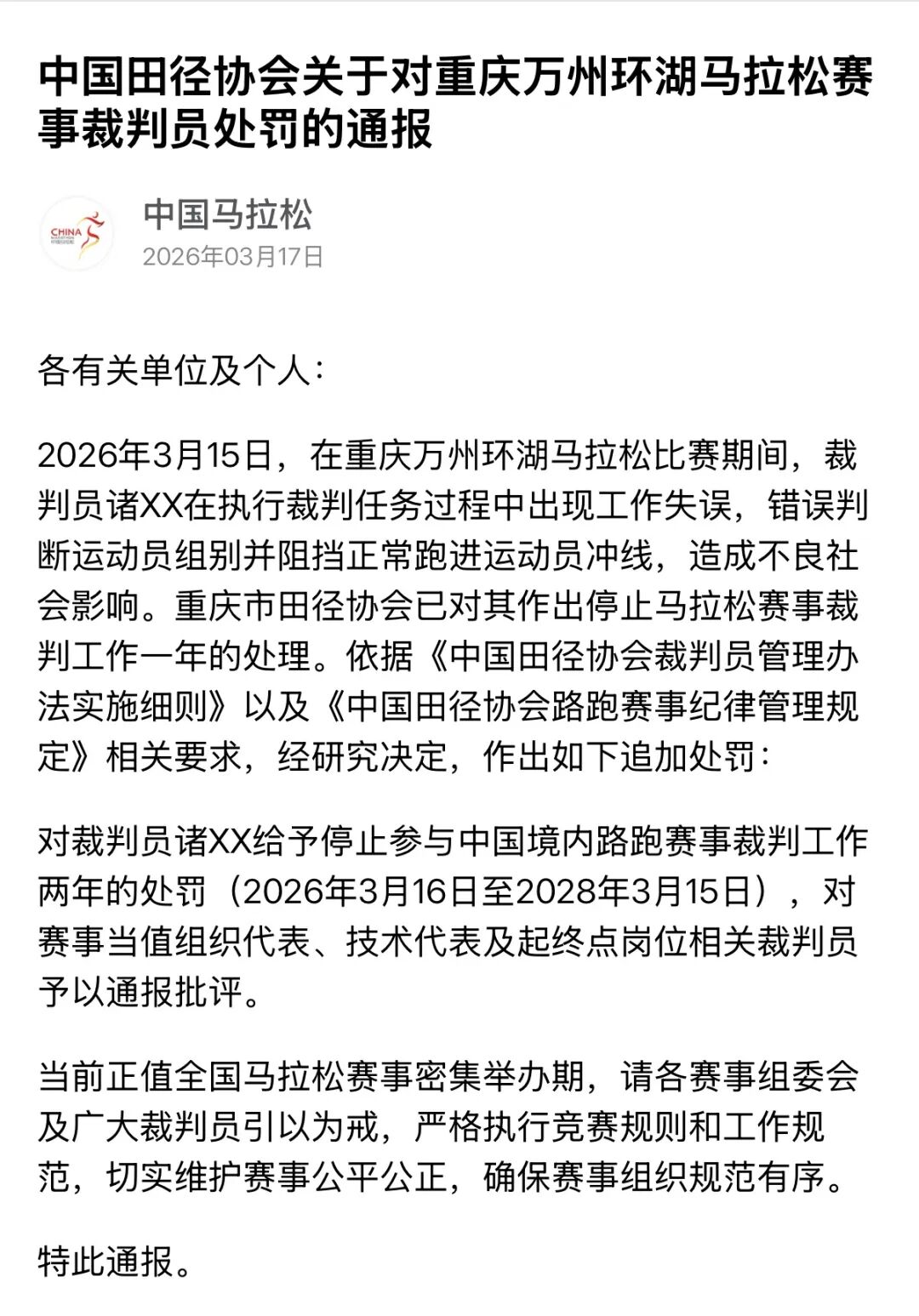
On March 17, 2026, the Chinese Athletics Association's official website published a disciplinary notice that sparked heated debate in the running community. In the March 15th Chongqing Wanzhou Lake Loop Marathon, referee Zhu XX misjudged an athlete's category and blocked a runner who was legitimately sprinting to the finish. Ultimately, the Chongqing Athletics Association suspended them from officiating marathon events for one year.Subsequently the Chinese Athletics Association imposed an additional, harsher penalty——
From March 16, 2026 to March 15, 2028 , the referee is banned from officiating road running events within China for two years, and the race representatives and start/finish referees involved have been issued a formal reprimand.
After the incident, discussion on social media has been nonstop. As runners and industry observers, how should we view this incident objectively?

There is no doubt that a judge blocking a competing athlete just before the finish line is an extremely serious officiating error. For every runner on the course, whether chasing PB or simply trying to finish, the moment of crossing the line is the most ceremonial and often when athletes are pushed to their physical limits.
Any unnecessary physical obstruction can not only affect an athlete's gun time or net time; after high-speed running or the physical depletion phase of“hitting the wall”, a sudden stop or evasive maneuver is even more likely to result in serious physical injury.
The notice clearly states the error was due to"misidentifying the athlete's category". In modern marathon start/finish management, organizers typically confirm competitors' identities using different-colored bibs, timing-mat feedback, and cross-checks across multiple positions. That this mistake occurred indicates the official made a judgment error in a very short period of time.
At the same time, the Chinese Athletics Association's notice did not single out an individual, but issued criticisms to the race's on-duty organizational representative, technical delegate, and the officials responsible for the start and finish positions.
This also objectively reflects that it was not simply an isolated blind spot of a single official, but that the race's finish-line flow management, position coordination, and even emergency protocols had systemic shortcomings.

However, while criticizing and holding those responsible for the mistake accountable, we as running-media outlets also urge the public to remain objective and neutral. Looking at the incident as a whole, this was indeed an error caused by work oversight and insufficient proficiency, not an act of deliberate sabotage."deliberate sabotage" incident.
In a marathon with tens of thousands of participants, the start and finish area is often the most pressured and complex "pressure cooker" of the event. When officials face a dense crowd sprinting across the line and complicated overlaps between categories, they must make judgments and give directions in the blink of an eye. In that process, a momentary tightening of nerves or lack of experience can indeed lead to improper actions.
The Chinese Athletics Association's"two-year suspension" is already quite severe and fully reflects the authorities' resolve to protect the fairness and integrity of races and to apply a zero-tolerance approach to rule-breaking and disorder. Since the relevant bodies have imposed heavy penalties in accordance with the 'Implementation Rules for the Management of Referees of the Chinese Athletics Association' and the 'Disciplinary Regulations', there is no need to excessively magnify the issue or subject the referee to online abuse on social media.
Elevating a work mistake into a moral condemnation not only does nothing to solve the practical problem, but also places excessive pressure on grassroots event workers.

As the Chinese Athletics Association said in its notice: "We are currently in a period of densely scheduled marathon events across the country". Every weekend, dozens of races across the country fire their starting guns at the same time. The episode at the Chongqing Wanzhou Lake Loop Marathon is a timely wake-up call for all race organizing committees and officials nationwide.
A marathon is not only a stage for runners to challenge themselves, it is also the ultimate test of an organizer’s capacity for refined operations. From sensible planning of start and finish flow lines and error-proof visual identification systems, to pre-race training and emergency drills for officials, every detail determines the professionalism of an event.
Criticism is for progress, and penalties are for regulation. Let mistakes stop at fines, and let discussions return to rational post-race reviews.
In the coming spring marathon wave, we hope to see more professional, seamless race organization, so that every runner can run unhindered on the course and smoothly cross their own finish line.