


Japanese marathon record-holder Suguru Osako has recently posted several messages on his personal social media.
Earlier he publicly voiced support for his junior Keita Sato, who has gone to the United States to begin a professional career. He also responded to the debate over 'who has the right to be called a professional runner,' arguing that professional status should not be determined by outside labels and judgments.
On July 29, Suguru Osako posted a long entry, lamenting that Japanese society is increasingly relying on rules rather than mutual understanding between people to keep order.
At the end of the post he wrote: “Japan is really becoming more and more suffocating. I'm going to train in Kenya!” — a remark that revealed his weariness with the current state of Japanese society.
01
Standing by Keita Sato, condemning keyboard warriors
Keita Sato, nicknamed the “Komazawa Monster,” previously delivered strong performances in the Hakone Ekiden. After graduation he decided to pursue a professional career overseas and joined Nike's Swoosh Track Club to train and focus on the track. That decision sparked a lot of discussion at the time, and some even questioned it.

In an interview with Sports Graphic Number, Keita Sato said he asked Suguru Osako for advice when they had dinner together.
“He told me to choose a place where I can get stronger, where I can truly improve. Ultimately, becoming stronger as an athlete is what matters most. So he told me to make achieving that goal my top priority.”

Osako also mentioned that he had dined with Keita Sato and discussed his future development in depth. He publicly expressed his support for the junior: "Let's cheer for Keita, who is working hard to prove his choice."
Responding directly to online criticism of Sato's career choice, Osako was blunt. He said he hopes those who enjoy criticizing others will stop posting trivial and unnecessary remarks and refrain from overstepping into athletes' own decisions.
02
Anyone can be a professional runner
Osako's unusually pointed response may be related to some netizens questioning whether Keita Sato was "even qualified to be called a professional runner." He then posted separately to address the controversy, arguing that judging an athlete by so‑called status or titles has no real meaning.
He wrote: "'Professional runner' is essentially a self-definition — anyone can call themselves that. The title itself doesn't prove anything."

Looking back at Osako's own career, he made a similar choice. In 2015 he left Japan's traditional corporate athletics team system to train and develop in the United States. That decision also did not win universal understanding at the time and attracted a fair amount of doubt and criticism.
Perhaps because he went through a similar situation, Osako can better understand the pressure Sato now faces. As someone who has walked that path, he chose to speak out publicly and support his junior's decision.
03
A society that governs by rules rather than mutual norms is suffocating
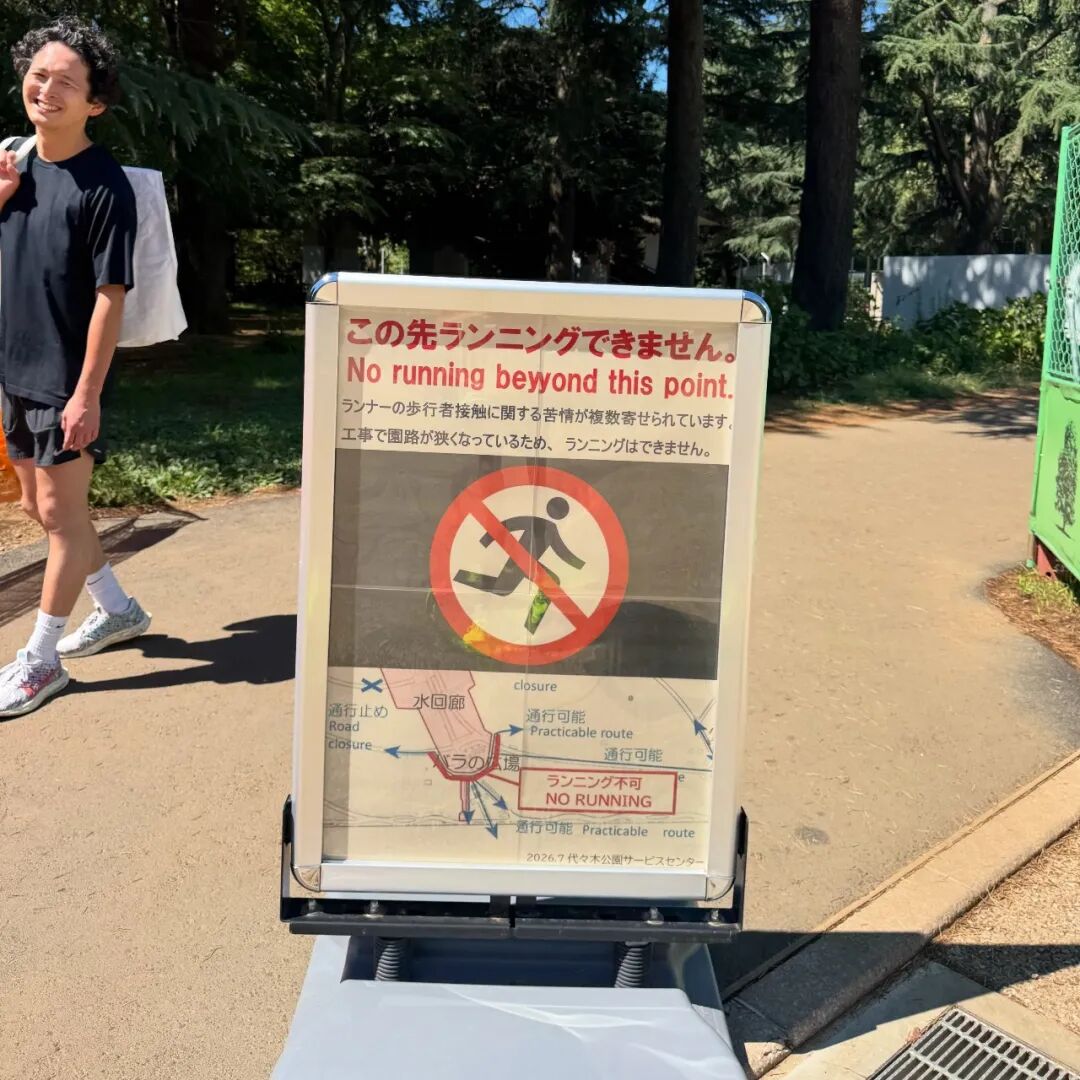

Yoyogi Park has long been a common training spot for Tokyo runners. In the past runners and pedestrians shared paths and avoided each other, relying more on mutual tacit understanding. Many running groups also remind members not to run side-by-side in large numbers during training, and to be mindful of pedestrians when stopping, to avoid impacting other path users.
But the park ultimately chose to put up signs explicitly banning running on certain sections. That prompted Osako to reflect: issues that could once be resolved through runners' self-discipline and mutual consideration now can only be constrained by written, enforceable rules — a regrettable shift.
[End-of-article interaction]
What do you think of the current running community culture? #
Text / Editor: 运动笔记 / JOJO
Photo source: Paoye Dabaozha / online
Visuals: Max