huiWorld Athletics recently updated the 2027 edition of the Label Road Race Regulations. The most significant changes focus on further raising the thresholds for upgrading to Gold status, including higher winner's prize standards, an increase in the number of elite athletes required, and a sharp rise in label fees.
The new rules are expected to take effect on August 3. These adjustments not only mean a significant rise in event organization costs, but also force domestic races to be more cautious when weighing financial and resource commitments while pursuing Gold and Platinum labels.Eligibility thresholds raised againAccording to the latest Label Road Race Regulations, the fee structure for different label tiers has been reworked, with a clear tiering effect. One of the most discussed points is that fees for the standard Label and Elite label have been reduced, while Gold and Platinum labels have risen sharply.
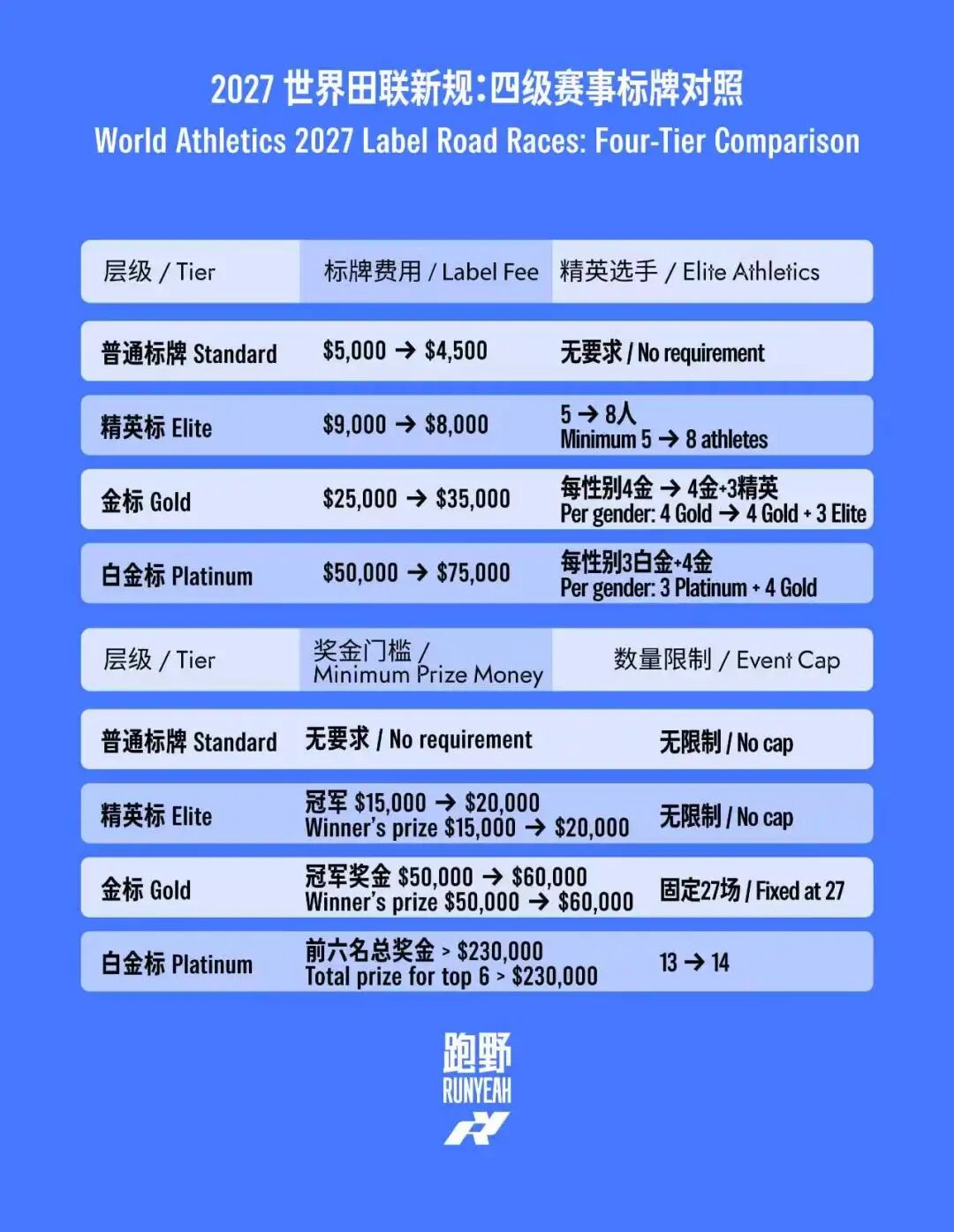
Going forward, the label fee for Gold races will increase from $25,000 to $35,000, and the Platinum label will jump from $50,000 to $75,000. Although these funds will be used directly for anti-doping programs and medical coverage, they are expected to become the first financial hurdle for organizing committees.By contrast, the standard Label fee is reduced from $5,000 to $4,500, and the Elite label falls from $9,000 to $8,000, creating a stark tiered difference.This difference clearly shows that World Athletics aims to use the lower entry costs of the standard Label and Elite label to attract more small- and mid-sized city marathons into the labeling system, especially events in emerging markets across Asia, Africa and Latin America, enabling more events to join the international accreditation system and broadening the global running map.Gold and Platinum labels represent the highest standards. Raising fees is intended to ensure that only events with genuine financial and organizational capability can maintain or upgrade their status, concentrating financial pressure on top-tier events to guarantee world-class safety and fairness.For emerging Asian marathons in particular, this fee could account for more than 10% of the total budget, forcing organizing committees to seek additional sponsorship and government support.An incentive for elite athletes?
Alongside rising label fees, prize money for elite athletes has also increased proportionally. For example, the winner's prize for Elite label races rises from $15,000 to $20,000.
For Gold races, the winner's prize ,increases from at least $50,000 to $60,000, and events applying for their first Gold upgrade are required to provide at least 170% of that standard, which means the winner's prize must be no less than $102,000.
Although the winner's prize for Platinum label races is the same as Gold at $60,000, the overall prize pool is larger: the total prize money for the top six will exceed $230,000.
This level of investment will be a necessary condition to attract the world's top marathoners,forcing events to allocate a larger proportion of their budgets to prize money— a hard requirement for label compliance. Any race without sufficient funding will not be able to upgrade.
But the upgrade to prize structures will also directly accelerate a 'spending race' in global marathons, intensifying competition between events; at the same time it could squeeze spending in other areas such as mass-participant services and improvements to the race experience.
This will be one of the biggest challenges created by the new rules,and it means organizing committees will have to bear a heavier financial load.
Stricter invitation criteria
Requirements for elite field composition have been significantly raised. For Elite label races the minimum has increased from at least five male and five female Elite athletes to at least eight of each, immediately raising the total to 16.Gold races must now guarantee at least four Gold-label athletes per gender, plus three Elite-label athletes, nearly doubling the overall scale compared with the past.While the rules do allow up to three Elite-label athletes to substitute for one Gold-label athlete, the overall quality and quantity of the field have been substantially raised.Platinum label events are even more demanding. The new rules require at least three Platinum-label and four Gold-label athletes per gender, which raises both the numerical and quality bar, meaning events must have sufficient top-tier resources and international influence.These adjustments directly increase organizational costs. Committees must spend more on invitations and hospitality—airfare, accommodation, training venues and logistics—which often exceed the prize money itself.World Athletics emphasizes that these elite-field upgrades are intended to guarantee competitive standards and international impact, but for Asian and especially domestic races these clauses will be harsh because they require meeting both numerical and quality criteria simultaneously.
[End-of-article interaction]
Text/Editor: Jim
Photo source: 跑野大爆炸
Visuals: Max